MEDITECH EXPANSE
Modernizing Clinical Workflows for a Multi‑Facility Health System
Overview
A large health system adopted Meditech Expanse to modernize clinical operations across inpatient, outpatient, and emergency settings. The organizational goals were clear: standardize workflows, reduce documentation burden, and increase data consistency across facilities — without disrupting frontline care.
I led components of the implementation focused on workflow design, clinical decision support, and cross‑team alignment to ensure Expanse would deliver measurable improvements in speed, accuracy, and usability.
The Problem
Before the transition, clinical workflows varied widely across facilities and departments. This created significant issues:
Inconsistent documentation patterns
Duplicated work across care teams
Delays in chart review and order entry
Limited visibility into patient status across settings
High cognitive load for new staff and float teams
Leadership needed Expanse to do more than “go live.”They needed cleaner, faster, system‑wide workflows that matched how clinicians actually work.
Client
HCA
Service
Meditech Expanse Implmentation
Industry
Hospitals
Year
2023

Approach
I partnered with clinical operations, IT, and end‑user groups to understand the existing patterns and pain points across the system. Through workflow shadowing, configuration reviews, and rapid feedback loops with nurses, physicians, and ancillary departments, several gaps emerged:
Redundant steps baked into legacy workflows
Order sets that were too generic or too long
Inconsistent naming conventions that slowed navigation
Documentation requirements that did not align with real clinical practice
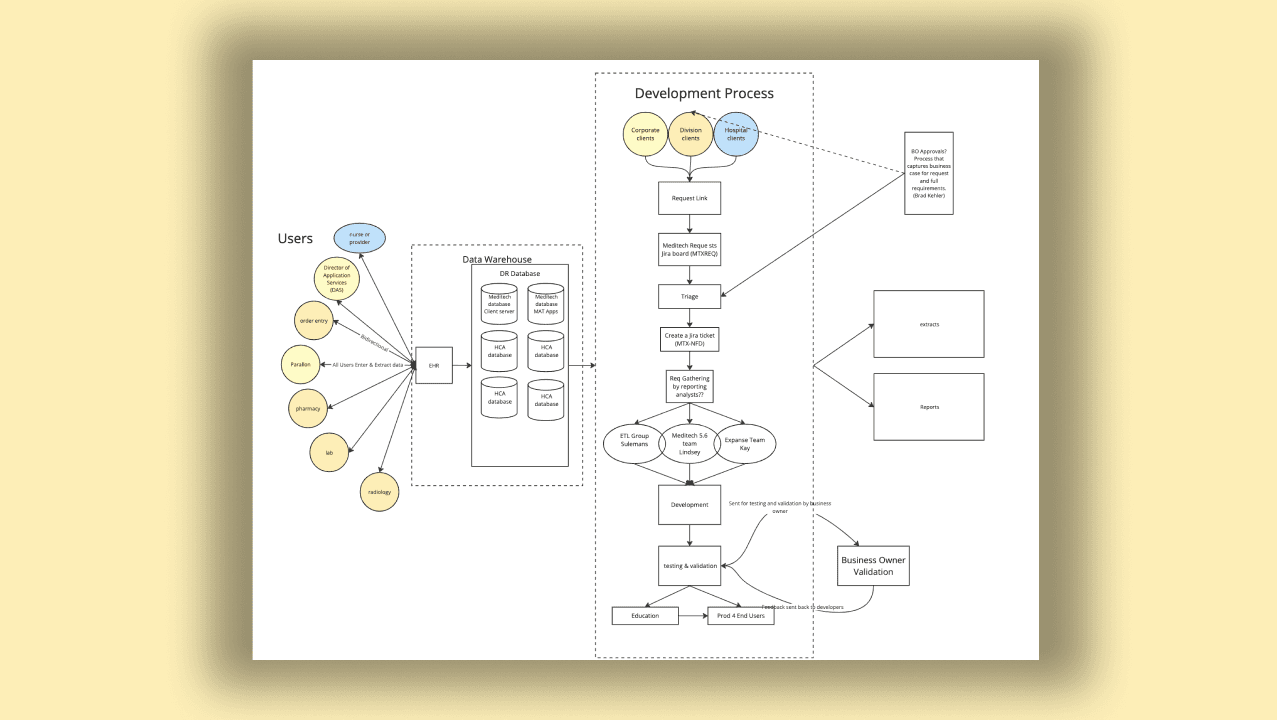
These findings guided the configuration, testing, and optimization phases of the implementation.
The Solution
Working with multidisciplinary teams, we redesigned key workflows to make Expanse faster, clearer, and easier to use:
Streamlined clinical documentation by removing duplicate fields and aligning forms with real‑world practice
Optimized order sets to reduce clutter and surface the most frequently used options
Standardized naming conventions so clinicians could move consistently across departments
Improved navigation pathways to reduce the number of clicks and screen changes per task
Coordinated training content to ensure all departments learned the same workflow patterns
Iterative testing with end users to validate usability and reduce friction before go‑live
The objective was not just to configure Expanse — but to ensure it worked the way clinicians think and move during actual patient care.
Impact
The implementation delivered measurable operational and usability gains across the health system:
Faster documentation times due to simplified forms and reduced redundancy
More consistent patient records across inpatient and outpatient settings
Shortened training and onboarding for new clinical staff
Improved navigation speed with standardized workflows and naming conventions
Higher adoption and satisfaction reported during go‑live readiness assessments
The system emerged with a cleaner, more predictable workflow backbone that supports safer and more efficient patient care.
What I Learned
EHR implementations succeed when configuration reflects actual clinical behavior, not idealized workflows.
The biggest takeaway:
Technology can streamline clinical work only when frontline staff shape the design.
Working closely with clinicians from the earliest stages ensured that Expanse wasn’t just installed — it was adopted, trusted, and used in ways that improved everyday care.